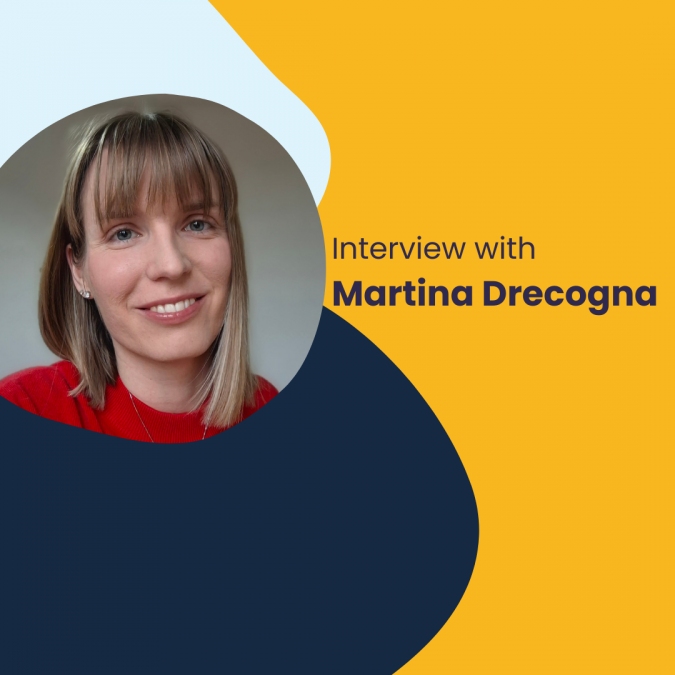
Algorithms in Diabetes Management: Expert Interview with Martina Drecogna
On the occasion of the International Day of Women and Girls in Science, we talked to Martina Drecogna (University of Padua) about how she got into medical informatics and why the use of algorithms is truly promising in diabetes management.
How did you become a computer scientist? Did you have a role model who inspired you?
I began my journey by studying bioengineering at the University of Padua, where I found a stimulating, high-quality environment that inspired me to continue working in research. I am currently a researcher at the University of Padua and a PhD student at the University of Pavia, supervised by Professor Chiara Toffanin and Professor Claudio Cobelli. Professor Toffanin is a great female role model for me. She shows me what I can achieve as a woman in the scientific field. At the same time, working with Professor Cobelli, a pioneer in this field, allows me to benefit from his extensive experience. Having both of them as role models is fundamental to my growth as a computer scientist.
Medical informatics is a highly promising field that has gained significant attention in recent years. What motivated you to enter this area of research?
I chose to become a bioengineer and to work in medical informatics because I wanted to use math for people. Science and math always came naturally to me, but I didn't want my work to be purely theoretical. I wanted it to have a social application. In medical informatics, we are building tools that help people live safer and easier lives. Seeing how math and algorithms can actually help manage a chronic condition like diabetes is highly rewarding.
Designing a control algorithm for accurate insulin delivery is a major responsibility. How does the algorithm ensure the safety of future users of the MuSiC4Diabetes device?
The algorithm acts as an artificial “brain” for the device. Its task is to monitor the body's levels and decide how much insulin to administer to prevent blood sugar (glucose levels) from falling or rising too much. We program it with very strict safety limits so that it cannot accidentally administer an excessive dose. This way, the user can feel safe and relaxed while the device does its job.
What are the main challenges that still need to be addressed?
One of the biggest challenges is to use the intraperitoneal route for insulin infusion, so that the device is completely internal without the need to wear anything on the skin and the insulin is injected in a more physiological way allowing for superior glucose control. However, we must ensure that the algorithm is sufficiently “intelligent” to manage the internal release of insulin with the highest precision, adapting perfectly to the unique biological responses of each individual patient.
How is the algorithm tested before people can use it as part of the closed-loop system?
Before it reaches a patient, we use what we call “in silico” tests. Essentially, we use highly advanced computer simulators that mimic human metabolism. This allows us to test thousands of different scenarios, such as eating a carbohydrate-rich meal or going for a run, to see how the algorithm reacts in a completely safe virtual environment. Only after passing these rigorous simulations we move on to clinical use.
How will computer science change the lives of people living with diabetes?
We hope that it will no longer be necessary to constantly do mental calculations. Most devices today only detect glucose, but our project tracks three parameters to get a complete picture. We monitor glucose, but also lactate, which is like an early warning signal that indicates the onset of physical activity, and ketones, which are like an alarm bell for dangerous complications. By observing all three parameters, the computer can handle the monitoring for you, so you can just live your life.