
MuSiC4Diabetes in Seville – Exploring the Opportunities and Challenges of Artificial Pancreas Research with Students
MuSiC4Diabetes partner Chiara Toffanin was invited to deliver four seminar lectures at the University of Seville from 14–18 May 2026, introducing students to different perspectives of Artificial Pancreas research. The seminars were integrated into courses on dynamical systems, automatic control, control engineering, and biomedical engineering, offering students the opportunity to apply their theoretical knowledge to a real-world case study at the end of the semester.
The overarching topic of the seminars was the Artificial Pancreas (AP), approached from different disciplinary angles. In the course on modelling dynamical systems, discussions focused on the high variability and uncertainty of closed-loop systems such as the Artificial Pancreas. The seminar on automatic control addressed advanced safety and security aspects of glucose regulation for people living with type 1 diabetes. Meanwhile, the control engineering course introduced students to advanced model predictive control strategies, while the biomedical engineering seminar provided an overview of the core components of AP systems, including sensors, actuators, control algorithms, and mathematical models.
Educational knowledge transfer activities such as these are highly valuable for projects like MuSiC4Diabetes. Demonstrating the importance of data-driven and machine learning approaches in biological research and innovative healthcare technologies is essential for strengthening European expertise and capacity building in this rapidly evolving field.
For Chiara Toffanin, artificial pancreas technologies for type 1 diabetes represent a groundbreaking area in which machine learning and advanced control systems can significantly improve patients’ quality of life. “The seminars highlighted how the next generation of engineers can play a crucial role in shaping the future of healthcare by transforming cutting-edge algorithms into real-world technologies capable of making a tangible difference in people’s lives,” concludes Toffanin.
Through initiatives like these, MuSiC4Diabetes not only contributes to advancing diabetes management, but also supports the education and skills development of future researchers and engineers.
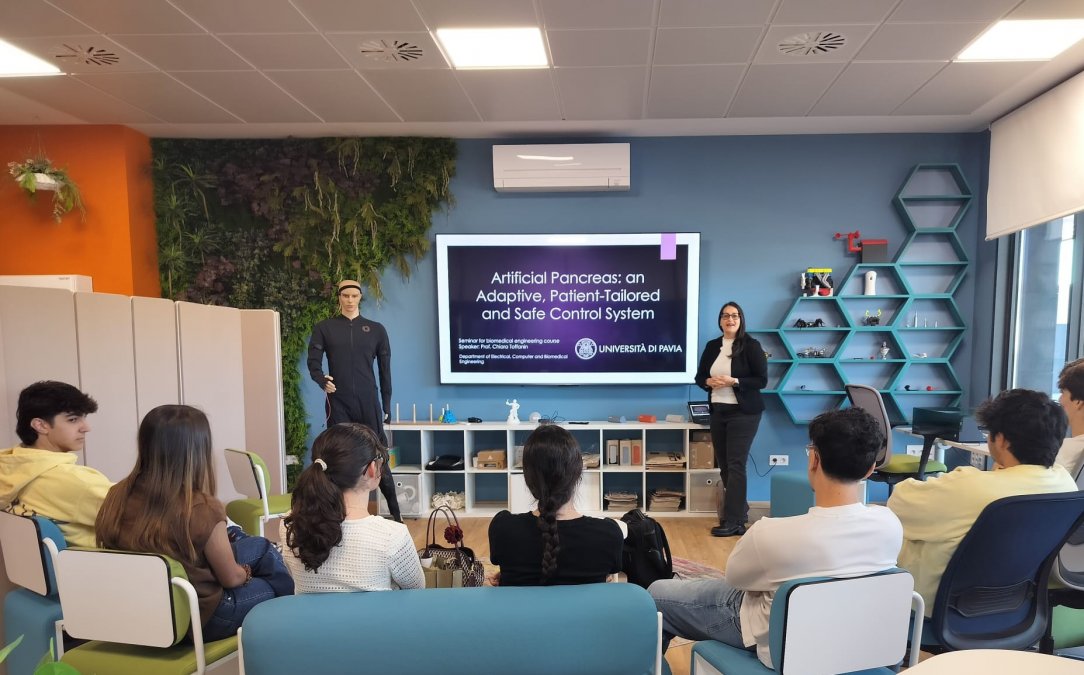 Chiara Toffanin while teaching students
 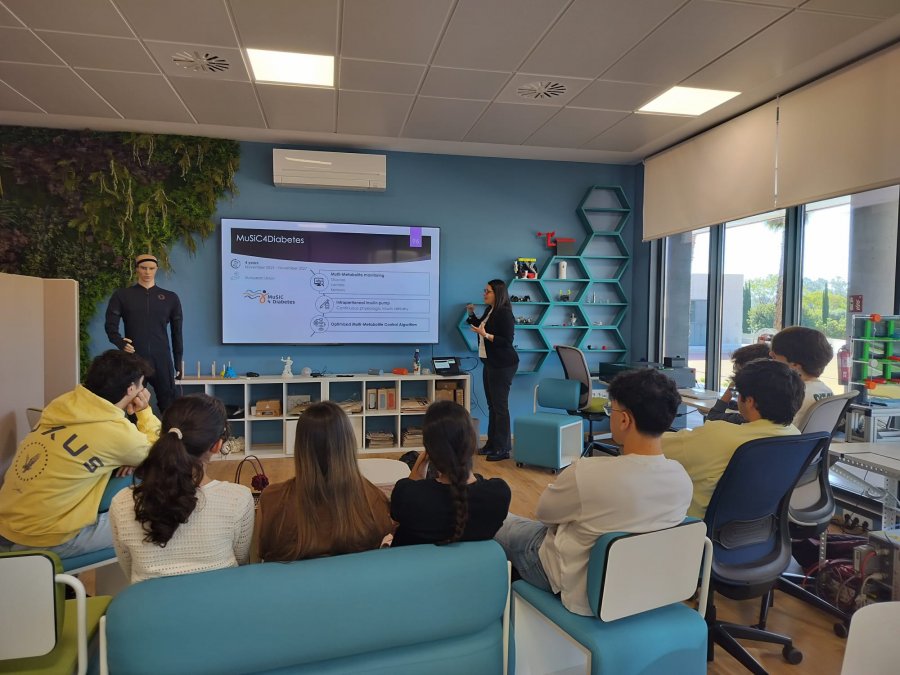 Introducing MuSicC4Diabetes